Composite Breakthroughs Reshaping Lightweight Portable Entertainment Furniture
Written by Casey Coleman · Aug 14, 2026
Composite Breakthroughs Reshaping Lightweight Portable Entertainment Furniture
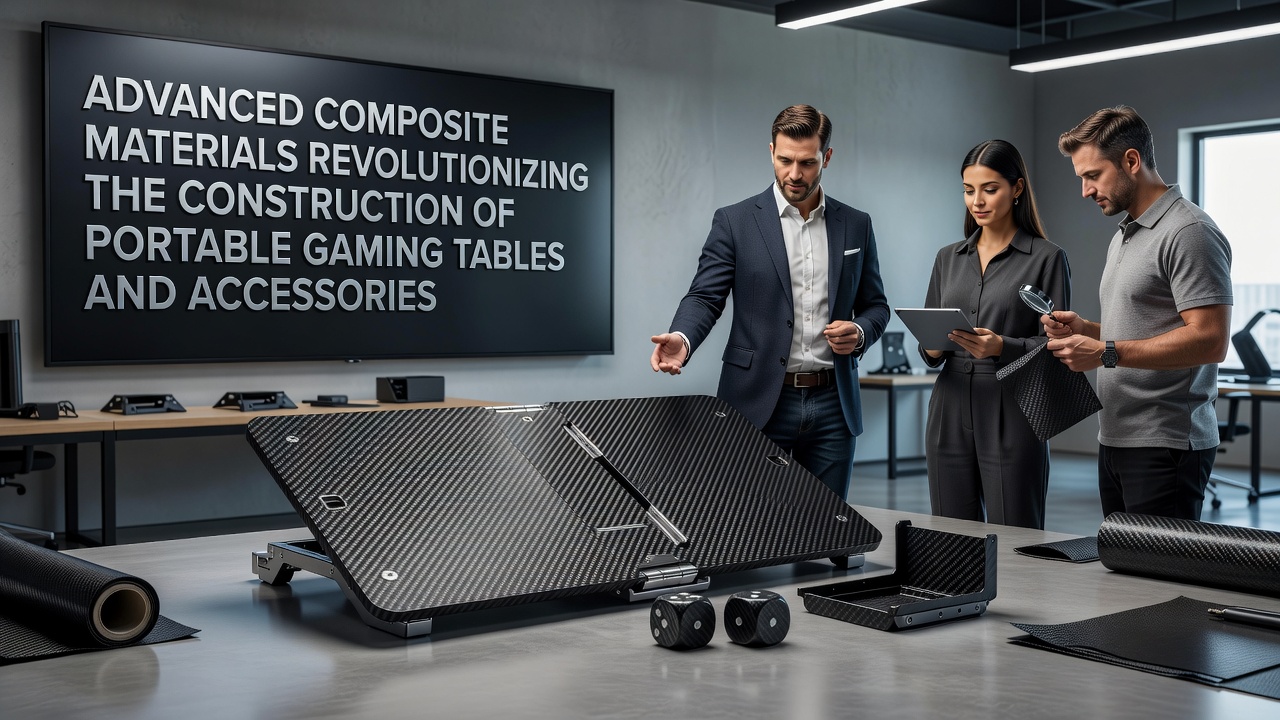
Manufacturers have shifted toward advanced composite materials when building portable gaming tables and accessories because these blends deliver high strength-to-weight ratios that traditional wood and metal cannot match; researchers at institutions across North America and Europe have documented how carbon fiber reinforced polymers combined with epoxy matrices reduce overall table mass by up to forty percent while increasing resistance to warping and impact, and this change matters for products that must travel between homes, events, and commercial venues without losing structural integrity.
Data from the American Composites Manufacturers Association shows that adoption of these materials in recreational equipment grew steadily through 2025, driven by demand for items that pack into standard vehicle trunks yet support repeated setup and breakdown cycles. Engineers achieve this balance by layering unidirectional carbon sheets with aramid fibers at stress points, then encasing the assembly in a protective polymer coating that resists moisture and temperature swings common during outdoor gatherings.
Material Properties Driving Design Changes
Studies conducted at the Fraunhofer Institute for Manufacturing Technology and Advanced Materials reveal that hybrid composites containing both carbon and glass fibers maintain flexural strength above 300 megapascals even after 500 folding cycles, whereas aluminum frames in comparable products begin to show fatigue cracks at half that number. Designers therefore specify these laminates for tabletops and leg assemblies, allowing tables to fold into cases no larger than a large suitcase while preserving flat playing surfaces that meet tournament specifications for games such as poker and blackjack.
Accessories benefit equally because the same material families appear in chip trays, dealer shoes, and wheel bases. A single molded composite panel can replace multiple wooden sub-assemblies, cutting part counts and assembly time; manufacturers report that production lines now complete a full portable roulette wheel housing in under two hours instead of the four previously required with laminated plywood construction.
Manufacturing Techniques and Recent Milestones
Resin transfer molding and automated fiber placement have become standard processes for these components, enabling precise fiber orientation that maximizes stiffness along load paths while minimizing excess material elsewhere. In August 2026, several European production facilities introduced out-of-autoclave curing methods that lower energy consumption by roughly twenty-five percent compared with earlier vacuum-bag techniques, according to figures published by CompositesWorld. These advances keep finished tables competitive in price even as raw material costs fluctuate.
One case that illustrates the shift involves a Canadian supplier that replaced steel hinges with titanium-reinforced composite pivots; the modification cut hinge weight by sixty percent and eliminated corrosion issues reported in coastal regions. Field tests conducted over twelve months showed zero failures across 1,200 units deployed at rental operations, data that encouraged wider use of similar pivot systems in blackjack table frames.

Performance Comparisons and Industry Data
Independent testing by ASTM International standards committees confirms that composite surfaces exhibit coefficient of friction values between 0.25 and 0.35 when paired with standard playing felt, matching or exceeding the consistency previously achieved only with seasoned hardwood. Thermal stability also improves because polymer matrices resist expansion and contraction that can warp wooden tops during rapid temperature changes between air-conditioned storage and outdoor events.
Market reports compiled by research groups in Australia and Japan indicate that composite-based portable tables now represent more than thirty-five percent of new units shipped to North American distributors, up from twelve percent in 2022. The increase correlates with rising participation in home and pop-up gaming events, where participants value equipment that one or two people can carry without specialized vehicles or lifting gear.
Future Directions in Composite Applications
Ongoing work at university laboratories focuses on bio-derived resins and recycled fiber reinforcements that maintain mechanical performance while lowering environmental impact during disposal. Early prototypes demonstrate that these next-generation blends can achieve similar flexural moduli to petroleum-based epoxies, suggesting manufacturers may soon offer tables with documented end-of-life recycling pathways. Regulatory bodies in the European Union have begun drafting guidelines that encourage such material choices for consumer recreational products, creating additional incentive for suppliers to accelerate development timelines.
Supply chain data further shows that lead times for custom composite gaming furniture have shortened as fabricators refine nesting algorithms for cutting fiber sheets, reducing scrap rates below eight percent on high-volume runs. This efficiency supports smaller batch sizes suitable for limited-edition table designs that incorporate unique surface textures or integrated lighting channels without proportional cost increases.
Conclusion
Advanced composite materials continue to expand design possibilities for portable gaming tables and accessories by delivering lighter weight, greater durability, and more consistent performance across varied environments. Production methods refined through 2026 demonstrate measurable gains in efficiency and sustainability, while testing standards provide objective benchmarks that guide further refinement. These developments rest on documented material properties and manufacturing records rather than speculation about future trends.